
AI is changing how customers discover products.
Instead of relying solely on traditional search engines, more consumers are turning to AI-powered assistants to help them research, compare and evaluate products before making a purchase. Whether it’s ChatGPT, Google’s AI-powered search experience, or other emerging tools, customers are increasingly asking questions and expecting direct answers.
For retailers, this shift raises an important question.
If an AI assistant was asked to recommend products from your catalogue today, would it have enough information to do so confidently?
Many businesses are focusing on how to optimise for AI search, but the reality is that visibility often comes down to something far less complicated: the quality of your product data.
AI recommends products it understands
Traditional search engines and AI assistants approach product discovery differently.
When someone performs a search on Google, they’re typically presented with a list of results and decide for themselves which products or websites deserve their attention.
AI assistants aim to go a step further. Rather than simply presenting options, they attempt to answer the user’s question.
A customer might ask:
- Which waterproof jacket is best for hiking in Scotland?
- What’s the best running shoe for starting?
- Which headphones offer the best value for daily use?
To answer those questions, AI needs context.
It needs to understand what a product is, who it’s designed for, its key attributes, how it compares to alternatives and the specific problems it solves.
Without that information, AI has little basis for making a recommendation.
This is why AI doesn’t recommend products because they contain the right keywords. It recommends products it can understand.
The hidden problem within many product catalogues
Most retailers don’t set out to create poor product data.
The challenge is that product catalogues often evolve over many years. New products are added by different teams, suppliers provide information in different formats, and standards naturally drift over time.
The result is a catalogue that may contain:
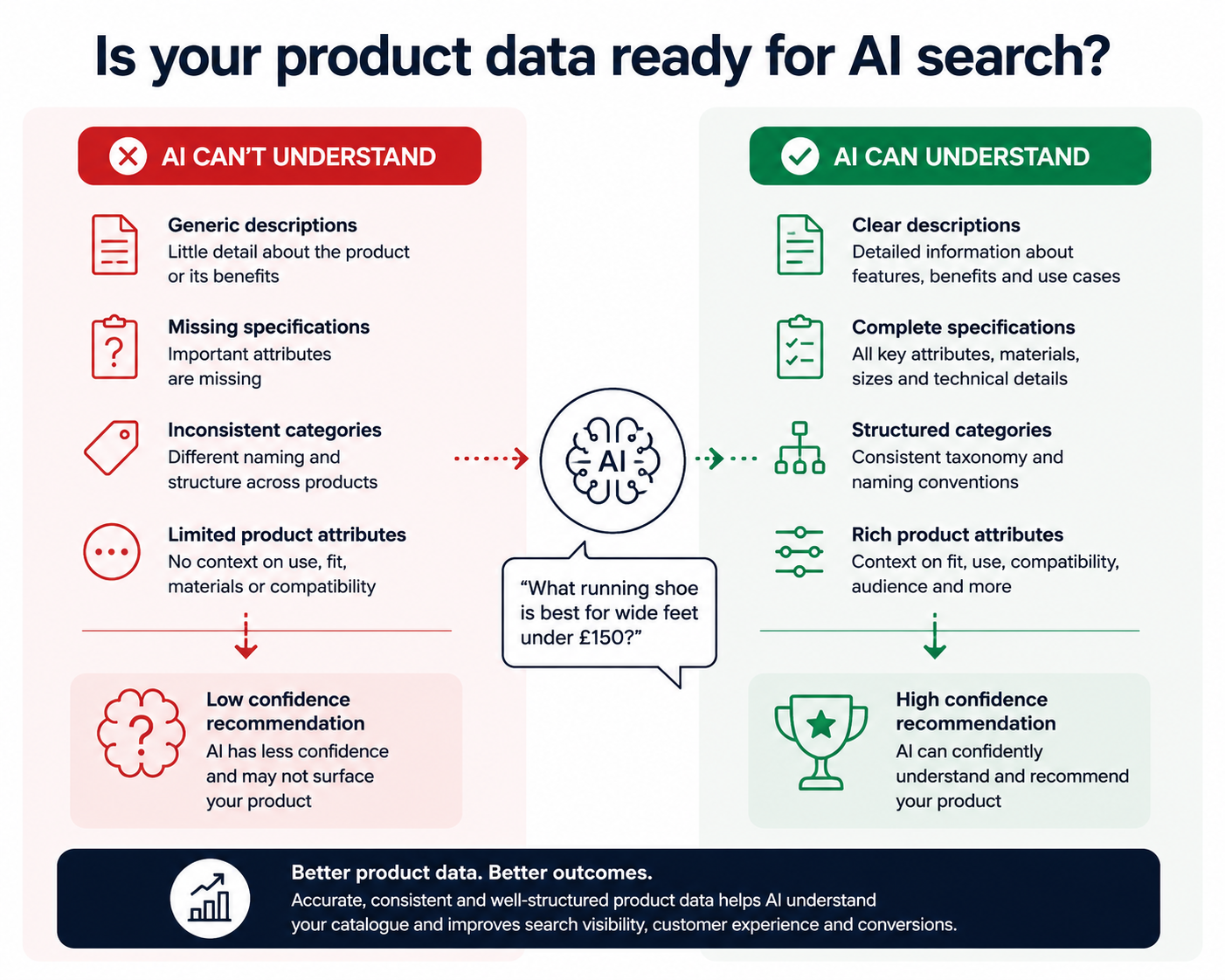
- Inconsistent product descriptions
- Missing specifications
- Poorly defined categories
- Incomplete product attributes
- Duplicate or conflicting information
- Limited information about product use cases
These issues can create friction for customers, but they create even greater challenges for AI systems.
A customer browsing a product page can often fill in missing information through experience, intuition or additional research.
AI cannot.
If a product description simply states that a jacket is “high quality and waterproof”, there isn’t enough information to determine who it’s for, what conditions it’s designed for or how it compares to other products.
The more gaps that exist within the data, the more difficult it becomes for AI to confidently recommend that product.
Why product attributes matter more than ever
One of the most valuable assets within any product catalogue is structured product information.
Attributes such as size, colour, material, waterproof rating, battery life, compatibility, dimensions and intended use provide context that AI can interpret and compare.
Consider a customer searching for a waterproof hiking jacket.
A product page containing detailed information about waterproof ratings, breathability, insulation, weight and intended use provides significantly more context than a generic marketing description.
The same principle applies across virtually every product category.
The more structured information available, the easier it becomes for AI systems to understand where a product fits and when it should be recommended.
Product descriptions need to do more than sell
Many product descriptions were written primarily with marketing in mind.
While persuasive copy remains important, product content also needs to provide clarity.
Effective product descriptions help both customers and AI understand:
- What the product is
- Who it’s designed for
- Key features and benefits
- Common use cases
- Important differentiators
- Limitations or suitability considerations
A generic description may sound appealing but provide little practical information.
A detailed description gives both humans and machines the context needed to make informed decisions.
As AI-powered product discovery grows, this distinction becomes increasingly important.
Structured data helps remove ambiguity
Structured data plays an important role in helping search engines and AI systems interpret product information accurately.
Schema markup allows retailers to provide clear information about products, including pricing, availability, reviews, brands and key attributes.
Rather than forcing systems to interpret information from unstructured content, structured data provides explicit signals that reduce ambiguity.
While structured data alone won’t solve every challenge, it forms an important part of making products easier to understand and discover.
Retailers that have invested in clean, structured product information are often in a stronger position as AI search continues to evolve.
AI readiness starts with product data quality
Retailers often ask what changes they should make to prepare for AI search.
In many cases, the answer starts with evaluating the health of their existing catalogue.
Questions worth asking include:
- Are product descriptions detailed and consistent?
- Are key specifications available across all products?
- Are product attributes standardised?
- Is categorisation logical and easy to maintain?
- Is structured data implemented correctly?
- Can someone quickly understand who a product is for and what problem it solves?
If the answer to several of these questions is no, there is likely an opportunity to improve how products are understood by both customers and AI systems.
The benefits extend far beyond AI search
One of the most interesting aspects of this discussion is that improving product data isn’t solely about AI.
The same improvements that support AI-powered discovery also support:
- Better customer experiences
- Improved search visibility
- Higher conversion rates
- More effective merchandising
- Stronger marketplace performance
- Better personalisation
In other words, the work required to prepare for AI search often delivers value across multiple areas of the business.
This is why product data should be viewed as a strategic asset rather than an operational requirement.
Final thoughts
AI search is creating new opportunities for customers to discover products, but it isn’t rewriting the fundamentals of e-commerce.
Retailers don’t necessarily need an entirely new strategy.
They need product information that is accurate, consistent, structured and useful.
The businesses most likely to benefit from AI-powered product discovery will be those that make it easy for AI systems to understand what they sell and who those products are designed for.
As AI becomes a larger part of the buying journey, the focus should move beyond visibility alone.
The more important question is whether your product catalogue provides enough context for AI to confidently recommend your products.
For many retailers, the answer begins with the quality of the data behind every product page.