
 Ante Primorac
When a merchant evaluates a commerce platform, the conversation starts with features. Does it support B2B? What payment gateways are available? Can it handle multi-currency? Feature checklists answer what a platform can do today. They say nothing about whether the platform will still be maintained well enough to run your business two years from now. Community health due diligence is the part of platform due diligence that feature checklists miss.
Feature checklists are the wrong first filter, and here is what we have learned evaluating open-source commerce platforms for client migrations.
The feature checklist trap
A feature matrix is a snapshot. It captures what exists at this moment. It does not capture whether the person who built that B2B module still contributes to the project. There is no signal in the matrix that the promotions engine you are counting on was last updated 14 months ago by a contributor who has since left the ecosystem, or that the issue backlog has been growing month over month, with new issues arriving faster than anyone is closing them.
Features without an active community behind them are liabilities that compound, not assets that appreciate.
The trap is that feature checklists make the evaluation feel rigorous. You can compare 20 dimensions across three platforms, score them, and get a number. The number feels objective, but it is objective about the wrong thing: the present state, not the trajectory.
Three community health due diligence metrics that predict platform viability
After evaluating platforms for multiple client migrations, including for teams later deciding to leave Shopify, we settled on a small set of community health due diligence signals that tell us more than any feature matrix. Here they are.
Contribution velocity
Look at the slope, not the absolute number. A platform with 50 monthly contributors that has held steady at 50 for two years is in a different position than one that went from 15 to 32 in six months. Flat is the warning sign. Growth is the confirmation. You do not need a large community. You need one that is still expanding.
Issue closure ratio
Compare how many issues are opened each month to how many are closed. A platform that closes 50 per month sounds healthy until you learn that 70 new issues arrive in the same window. The backlog grows invisibly, and by the time a merchant notices (stuck on a bug with no response), the backlog has been compounding for a year.
Contributor diversity
A working rule of thumb: if one company or one person accounts for the large majority of commits, the platform has a single point of failure. That company changes strategy, gets acquired, or loses the key engineer, and the project stalls. Standards bodies like CHAOSS publish more formal versions of this under bus factor and contributor concentration metrics, but the practical signal is the same. Look at the share of the top contributor.
Reading the numbers in practice
Few open-source commerce platforms publish their community health data at all. That silence is its own signal: a project that will not show you its contributor and issue numbers is asking you to take its viability on trust.
For the platforms that do publish, the healthy pattern is unmistakable. Contributor count is rising, not flat. Closure is outpacing creation. The backlog is shrinking, not growing. When all three move the right way, you are looking at a project that is compounding, not coasting.
The warning pattern is the inverse, and it usually shows up one metric at a time. Velocity goes flat while the backlog quietly grows. Closure looks fine in absolute terms until you compare it against the rate of new issues. A community can look busy and still be falling behind.
None of these numbers speak to contributor diversity on their own. That is a separate check: whether the work is distributed across companies or concentrated in one. Run it alongside the velocity and closure numbers.
What a decaying community costs you in production
Here is what nobody mentions until you are in production: the cost of a platform with a shrinking or stagnant community is not a one-time event, and the cost shows up in three places that compound against each other.
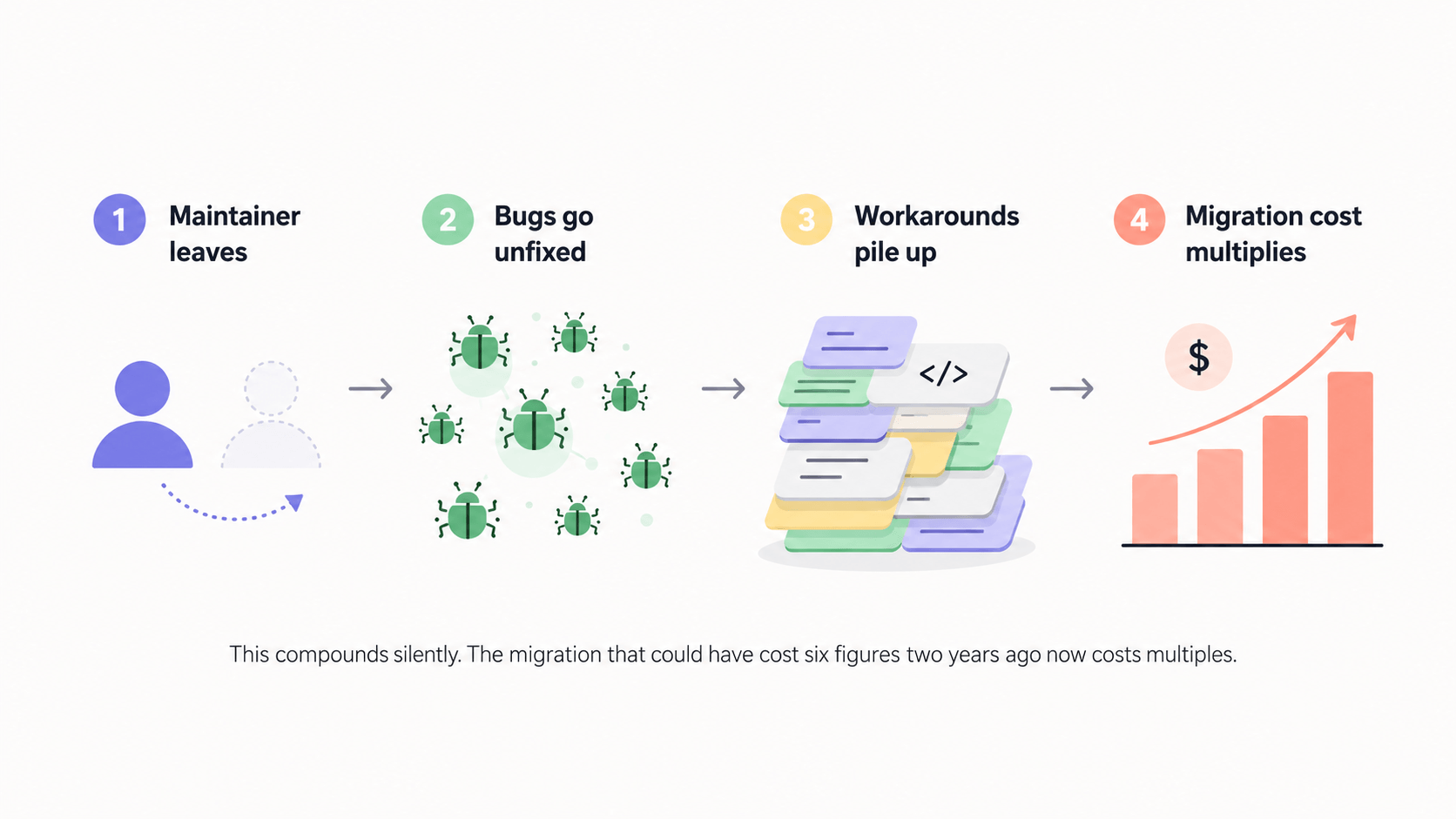
Bug fixes take longer
When the maintainer who owned the promotions module stops contributing, bugs in that module do not get fixed. They get worked around. Each workaround adds complexity. Each layer of complexity makes the next migration harder.
Extensions go stale
An ecosystem with declining contributors cannot maintain its plugin library. What worked on installation day slowly degrades as dependencies update around it. Six months later, that payments plugin throws deprecation warnings. A year later, it breaks on a minor version bump and no one is there to fix it.
Migration pressure builds silently
The merchant does not wake up one morning to a broken platform. The decline is gradual: slower responses, fewer releases, growing workarounds. By the time the pain is acute enough to justify a migration, the technical debt that has accumulated under the surface pushes the cost into multiples of what an earlier planned migration would have been.
Here is the decision you are actually making when you choose a platform without evaluating community health due diligence: you are betting that the community will stay healthy for as long as you need the platform. That bet may pay off. But you should at least know you are making it.
Run community health due diligence in under an hour
The three metrics above (velocity, closure, diversity) translate into four concrete checks. You can run all of them in under an hour.
Open the GitHub repository and pull up the contributors graph on the Insights tab. Look at the 12-month trend for the velocity signal: how many people contributed last month vs. six months ago.
Then go to the Issues tab and compute the open-vs-closed ratio for the closure signal. How many are open, how many were closed in the last 30 days, and whether the backlog is shrinking or growing.
Next, look at the Pull Requests page and the commit history for the diversity signal. How long do open PRs sit before someone responds? Is the commit graph still active, or did it go quiet three months ago? Cross-reference the top contributors against the organisations they work for.
Finally, check who funds the project. A single corporate sponsor is better than nothing, but multiple sponsors, especially a mix of companies and individual contributors, is stronger.
The bet you are actually making
Choosing a platform without checking community health is a bet that the community will stay healthy for as long as you need it. Community health due diligence is what turns that bet into a decision, and owning your commerce platform starts with knowing which indicators to track.