Commerce platform ownership does not mean running every server yourself. It means maintaining control over the rules and workflows that make your business different, while using managed services that remove work without taking away important decisions.
You might notice the need when a pricing change needs another app, an inventory problem needs a workaround, and opening a new market turns into a platform project.
Commerce platform ownership is not self-hosting
The phrase “own your commerce” can sound like an argument for self-hosting everything. It is not.
Managed hosting, databases, search, monitoring, email, and payment providers can all be sensible choices. Running those services yourself does not automatically make you more successful in commerce. It usually gives you more work.
The parts worth owning are different. They are the data model, pricing logic, customer and company structure, inventory behavior, order lifecycle, integrations, and the ability to change them without waiting for a platform extension.
A brand can run its commerce backend on managed infrastructure and still own those decisions. It can also self-host a platform while remaining dependent on third-party apps that control the core parts of the business.
Ownership is about control of decisions, not a badge on the architecture diagram.
When a commerce platform starts costing you
Packaged platforms are good at standard commerce. That is why they are useful.
The trouble starts when a business outgrows the standard model but keeps trying to fit inside it. A new requirement gets solved with an app. Then another app is added for the data the first app does not understand. The storefront is customized to hide the gaps.
For a while, the setup looks fine. The cost appears later in coordination.
We have seen this in B2B work. Before we built Viessmann‘s Medusa marketplace, their ERP owned contract prices, the commerce platform calculated promotions, and a separate service owned inventory, each system working independently. The problem surfaced at checkout: nobody could say which price should win or when stock was actually reserved.
That is not a missing feature. It is an ownership problem.
The same pattern appears in other places. A business adds a payment provider to work around one restriction, but the platform still controls the product category. A brand adds a custom frontend, but the platform still controls checkout and merchant access. The workaround changes the visible symptom without changing the dependency.
Headless commerce does not mean backend ownership
Headless commerce means the storefront and the commerce backend are separate systems. That separation can be useful. The team gains more control over the frontend, the release process, and the customer experience.
It does not automatically get control over products, prices, orders, or platform policies.
A headless Shopify build can still leave Shopify in charge of the product model, checkout, order lifecycle, payment configuration, customer accounts, and store access. If Shopify changes a product policy, the custom storefront does not create an exemption.
A simple test: pick one important workflow and follow it through the system. Take contract pricing. Trace where the price is decided, which system can override it, and what happens when the ERP and the commerce platform disagree. Who fixes the problem when a customer has already placed the order?
If the answer depends on manual coordination among several systems, the business does not yet own that workflow.
Which commerce workflows should you own?
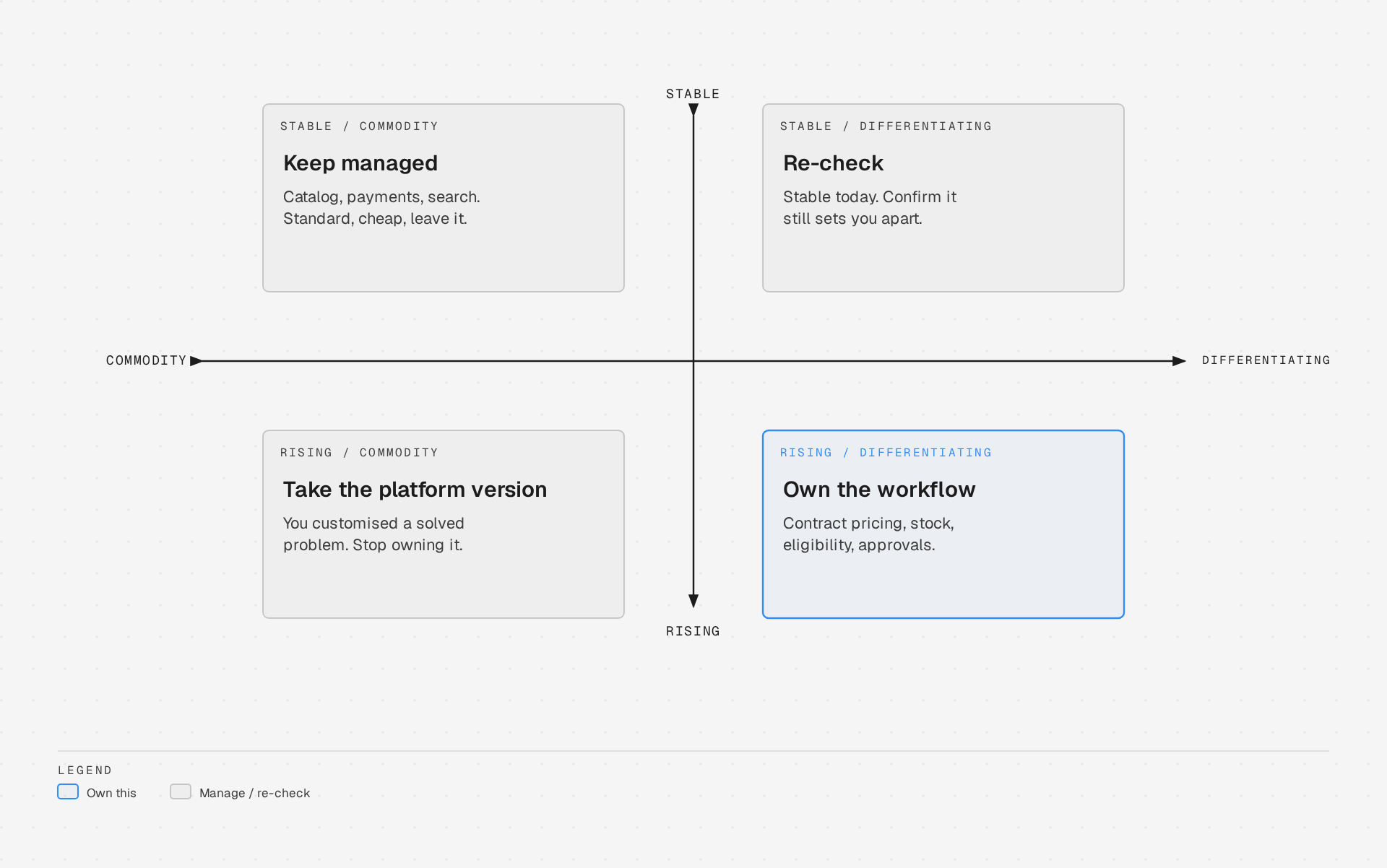
Not every capability deserves the same level of control. Standard catalog display and common payment behavior can remain managed if they are not differentiating the business.
The calculation changes when a workflow affects revenue, operating capacity, or the ability to enter a market. Examples include:
Revenue workflows
- Contract pricing for dealers
- Stock allocation across warehouses and stores
Operating model workflows
- Eligibility rules for regulated products
- Approval flows for B2B accounts
- Returns that need to coordinate with a warehouse or ERP
These are not custom features for their own sake. They are part of how the business operates.
If the platform makes each change expensive, slow, or dependent on another extension, owning that part of the system may be justified. The important word is part. You do not need to replace every service to take control of the decision that is holding the business back.
The cost of a custom commerce backend
A custom commerce backend gives you room to model these workflows. It also gives you responsibility for them.
The team has to own upgrades, security, monitoring, deployment, retries, support, and recovery. Someone has to decide who can change a price rule. Someone has to investigate a failed inventory reservation. Someone has to explain an order state to customer support six months after launch.
Medusa can support this kind of backend through its modules, workflows, custom entities, and integration patterns. It handles the structural work (data modeling, workflow orchestration) but deployment, monitoring, and upgrades still belong to the team. It does not remove the work. It moves it from platform workarounds into a system the business can shape.
That can be the right trade. It is not automatically the cheaper one.
This is the decision you are actually making: not which platform to use, but who owns the fix when something breaks and how much that fix costs over three years of operations.
How to map commerce platform ownership
Before changing platforms, make a small table for the workflows that matter:
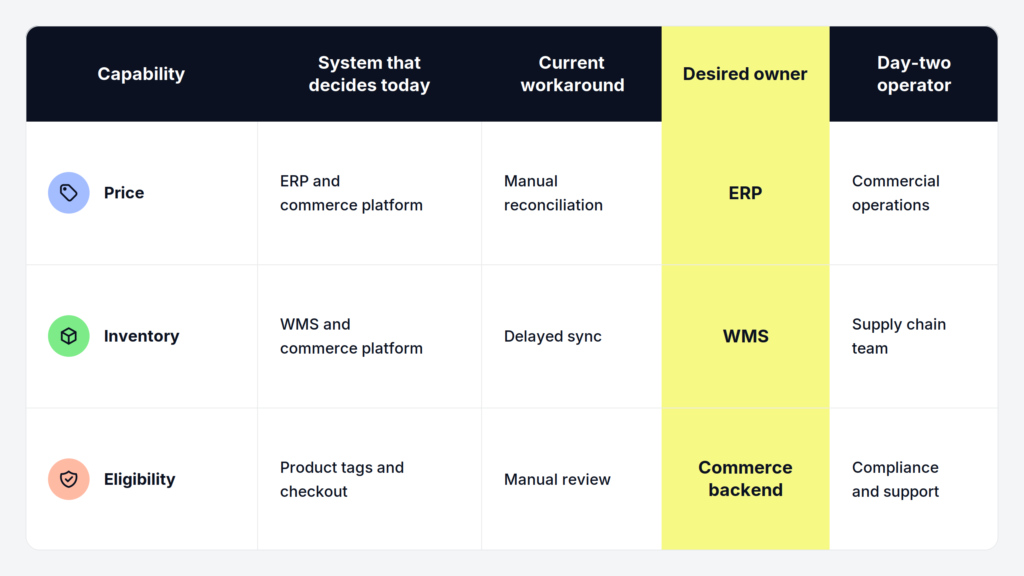
You do not need a perfect architecture document. You need to see where decisions are split between systems and who is responsible when they disagree.
That map may tell you to stay on Shopify. If your workflows are standard and your team lacks the capacity to operate a different backend, taking on more ownership may create more risk than it removes.
It may also show that you are already paying for ownership through apps, manual work, delayed launches, and reconciliation. This is the same pattern that makes platform dependency a business risk. We covered one example with Shopify’s category restrictions, but it shows up in subtler forms long before a platform policy makes the news.
Conclusion
Commerce platform ownership is worth pursuing when a platform constraint affects a decision that matters. Start with one workflow, not a full replatforming plan. Measure how long it takes to change, how many systems are involved, how often people correct it manually, and who owns the result when something fails.
If the workflow is standard and the cost is stable, keep it managed. If the cost keeps rising, take back the specific layer that is causing the problem. You do not need to own everything. You need to own the decisions you cannot afford to outsource.